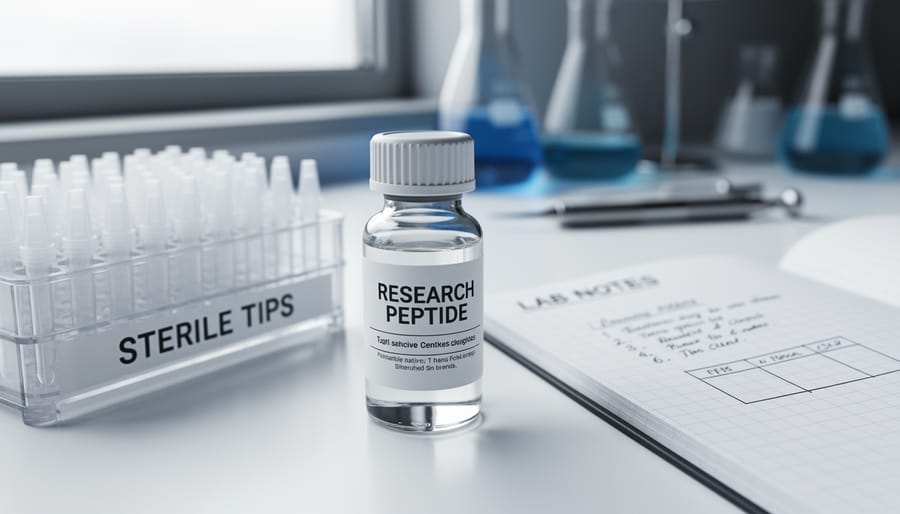
“Research use only” on a peptide label means the product is sold for laboratory investigation by a Canadian research peptide supplier not for people or animals to take, and it carries none of the quality checks that approved medicines go through. Think of it like the destination board at a station: a few words that tell you exactly where this ticket is valid, and where it isn’t.
Every good trip starts with reading the details before you board, and the same habit pays off here. Just as you’d check the fine print on a Montreal to Toronto fare before settling into your seat, a peptide label deserves a careful look before you trust it. Reputable sellers use the phrase to define the intended audience: qualified researchers working in controlled settings.
What the wording doesn’t tell you is just as useful. It isn’t a safety rating, a purity guarantee, or a green light for personal use. This guide walks you through what the label signifies, why it exists, how Canadian rules shape it, which warning signs to watch for, and where to turn for personal health questions. Consider it your timetable for reading the fine print with confidence.
What “Research Use Only” Actually Means

Peptides in Plain Language
Think of a peptide as a short train. Each amino acid is a single car, and when a handful of them are coupled together in a particular order, you get a peptide. Link many more cars into a much longer chain and folded structure, and you’ve got a protein. The order of the cars matters enormously, since a small change can give the whole train a different job.
That’s why researchers find peptides so interesting. They’re small enough to study and build in a laboratory, yet they can play meaningful roles in biology. Some work in areas like cellular energy peptides are explored, for example, and scientists use them to see how cells behave.
Before we hit the label itself, here’s a quick glossary to keep handy:
- Peptide
- A short chain of amino acids linked together, like a few train cars coupled in a set order.
- Research use only (RUO)
- A label stating the product is intended for laboratory research, not for use in humans or animals.
- Certificate of analysis (COA)
- A document reporting test results, such as identity and purity, for a specific batch.
- Batch/lot number
- An identifier that ties a vial to one production run, much like a ticket number ties you to one journey.
With those terms in your pocket, the rest of the trip gets much smoother.
What the Label Does and Doesn’t Tell You
Think of the “Research Use Only” statement the way you’d think of a ticket marked “Station Access Only.” It tells you where the thing is meant to go and what it’s meant to do. It doesn’t tell you the journey is safe, scenic, or even possible for you.
That’s the heart of it. RUO describes intended use. It says the product was made and sold for laboratory work, not for people or animals to take, and not as a medicine, supplement, or diagnostic. It is not a quality rating, and it is not an endorsement.
What it signals, quietly, is what hasn’t happened. A product with this label hasn’t been evaluated by a regulator for human consumption. Nobody has reviewed it for the way approved medicines are reviewed, with studies on safety, correct dosing, and side effects. It also doesn’t carry the safeguards that come with approved products, such as controlled manufacturing standards, consistent quality checks, and clear instructions written for patients.
Just as important is what the label can’t promise. It doesn’t guarantee purity. It doesn’t confirm that the contents match the name on the vial. And it doesn’t suggest the product is safe outside a controlled lab setting.
So the phrase is best read as a boundary line. It marks the edge of what the seller is claiming, and everything beyond that edge is simply unverified. For personal health questions, a qualified healthcare professional is the right person to ask.
Why the Label Exists: A Quick Look at the Rules

Every journey has rules that decide who can board what. Rules around research materials work the same way. Regulators in most countries draw a firm line between substances made for laboratory experiments and products approved for people to take, and the “research use only” label sits right on that line.
The reasoning is simple. Approved drugs go through testing for safety, quality, and effectiveness, and their manufacturing is overseen. Supplements and similar consumer products face their own oversight and labeling expectations. Research materials are made to support experiments, such as testing how a compound behaves in a controlled lab setting, so they usually aren’t held to those consumer standards. The RUO label tells everyone along the supply chain which category the product belongs to.
Here’s a general comparison. Details vary by country, so treat it as a broad orientation rather than a legal reference.
| Feature | Research-use-only products | Approved drug products | Regulated supplements |
|---|---|---|---|
| Intended use | Laboratory experiments only | Treating or preventing a condition | General dietary or wellness support |
| Oversight | Generally limited to research-supply rules | Extensive regulatory review and monitoring | Category-specific rules set by regulators |
| Labeling expectations | Must state it is not for human or animal use | Detailed directions, warnings, and ingredient information | Ingredient lists and permitted claims |
| Safety evaluation | Not evaluated for human consumption | Assessed before and after approval | Varies by jurisdiction and product type |
The practical takeaway is that marketing an RUO product for personal use can create legal and safety problems, because it asks a research material to do a job it was never reviewed for. That’s why a label saying “not for human use” paired with suggestions about taking the product is a mismatch worth noticing.
Rules also change over time, and they differ from place to place. Before drawing any conclusions, check current guidance directly from official sources such as Health Canada, much as you’d confirm a timetable before heading to the station.
How to Read a Peptide Label Like a Seasoned Traveller

Decoding the Certificate of Analysis
A certificate of analysis, usually shortened to COA, is a document that reports what testing found in one specific batch of a product. For a peptide, that typically means two things: identity (is this the compound the label says it is?) and purity (how much of the material is the target peptide versus leftovers from manufacturing). You’ll often see results from methods like HPLC for purity and mass spectrometry for identity.
Here’s where the traveller’s habit pays off. Just as you’d read a label like a timetable checking every detail against what’s in front of you, a COA only means something if it lines up with the vial in your hands. The lot or batch number on the document should match the one printed on the label exactly. Rail staff rely on precise identifiers to keep things on track, and the same logic applies to batch numbers. If the numbers differ, or the COA lists no batch at all, the report can’t be tied to that product.
It’s also worth being clear about what a COA can’t do. A document is a claim about testing, not proof that the testing was done well, or done at all. A COA might come from the seller’s own lab, may be easy to copy or edit, and says nothing about whether the product is suitable for any use beyond research. Independent verification, meaning testing by a third party that has no stake in the sale, carries more weight than a paper the supplier supplies themselves.
Think of the COA as one useful clue, not a final answer.
Red Flags and Common Misunderstandings
Even a careful traveller can board the wrong train if the signs say two different things. Labels work the same way, and the clearest warning sign is mixed messaging. A vial marked “research use only” is telling you it belongs in a laboratory. If the same seller’s website or packaging then hints at personal use, offers dosing instructions, or makes health claims, the seller is contradicting the label’s own intent. Those messages can’t both be true, and the label is the part that carries the legal weight.
Other signs worth noticing include missing batch numbers, no supplier contact details, vague or absent testing documents, and testimonials describing what people felt after using a product. None of these prove wrongdoing on their own, but together they suggest the label is a formality rather than a commitment.
It also helps to clear up a few common myths:
– “RUO means higher grade.” It doesn’t. The label describes intended use, not quality tier.
– “A polished label means it’s approved.” Professional design is a marketing choice, not a regulatory stamp.
– “A disclaimer makes anything acceptable.” A disclaimer can’t change what a product is actually being promoted for.
So what does the label really offer? Here’s a balanced look:
Pros
- It states the intended scope clearly: laboratory research, not consumption.
- It helps legitimate researchers get materials for experiments.
- It separates research materials from approved medicines and supplements.
Cons
- It gives no assurance of safety or quality for personal use.
- It doesn’t mean the product has been evaluated or approved by a regulator.
- It can be used as a marketing shield by sellers who promote products for other purposes.
The takeaway is simple: treat the label as information about intent, not a seal of trust. When the words on the vial and the words around the sale don’t match, that mismatch is your signal to pause and ask a qualified professional or check official guidance, such as Health Canada, before going any further.
Quick Answers to Common Questions
Are research use only products meant for human use?
No. The label states that the product is intended for laboratory research, not for people or animals. It isn’t sold as a medicine, a supplement, or a diagnostic tool, and it hasn’t been evaluated for those purposes.
Does “research use only” mean a product is regulated like a medicine?
Not at all. Approved medicines go through testing and oversight that RUO materials simply don’t. The label describes what the product is meant for. It isn’t a seal of approval, and it doesn’t promise anything about safety or quality. Think of it like a ticket marked “not valid for travel”: it tells you what the item is for, not that it’s cleared for the journey you have in mind.
Why do some sellers add disclaimers?
Often because the product is being described in a way that doesn’t match its stated purpose. A disclaimer on its own doesn’t change what a product is or how it can legitimately be used. If the label says one thing and the marketing suggests another, trust the caution, not the sales pitch.
Does RUO mean higher quality?
No. It describes intended use, not grade. A professional-looking label or a polished website tells you nothing about what’s actually in the vial.
Where can I find reliable information?
Start with official regulators. In Canada, Health Canada publishes guidance on health products and what’s authorized for sale. For anything touching your own health, a doctor or pharmacist is the right person to ask. For legal questions, a qualified legal professional can give advice that fits your situation. General articles like this one are a starting point for understanding, not a substitute for that guidance.
Every great rail journey begins before the train even pulls out of the station. You check the ticket, confirm the platform, and read the conditions, because the details save you from surprises down the line. Product labels reward the same habit.
Here’s the short version of the trip so far. “Research use only” describes a product’s intended purpose: laboratory work, not human or animal use. It exists because researchers need materials for experiments, and regulators treat those materials differently from approved medicines or supplements. A careful reader checks the RUO statement, the batch number, the storage details, the supplier information, and whether a certificate of analysis actually matches the vial in hand. And mixed messages, like an RUO label paired with personal-use suggestions or health claims, are worth noticing.
For personal health, legal, or safety questions, talk with a qualified professional and check official sources such as Health Canada. They’re your best conductors for that stretch of the route.
Curious what else a little preparation can do? Keep exploring The Cross Train for more practical planning tips. Happy travels!